OTL implementation that holds up at the first data drop
Your contract says asset data must follow the owner's object type library. Thousands of assets, hundreds of thousands of attributes, and one delivery format the client will check line by line. We make that work in practice, from the first mapping to the final handover.
"Most OTL problems are not technical. They are process problems. Who fills which attribute, when, and how it gets validated before it leaves your hands. We have seen the data drop fail at the last minute too many times to treat that question as an afterthought."
Sylvia Awoudu · Co-founder & COO, SøDera
Understanding the discipline
What is an object type library?
An object type library, usually shortened to OTL, is the agreed list of every kind of object an asset owner manages, together with what must be known about each one. You will also hear it called a reference data library, an ontology, or in the Netherlands an objectenbibliotheek. The names differ, the job is the same.
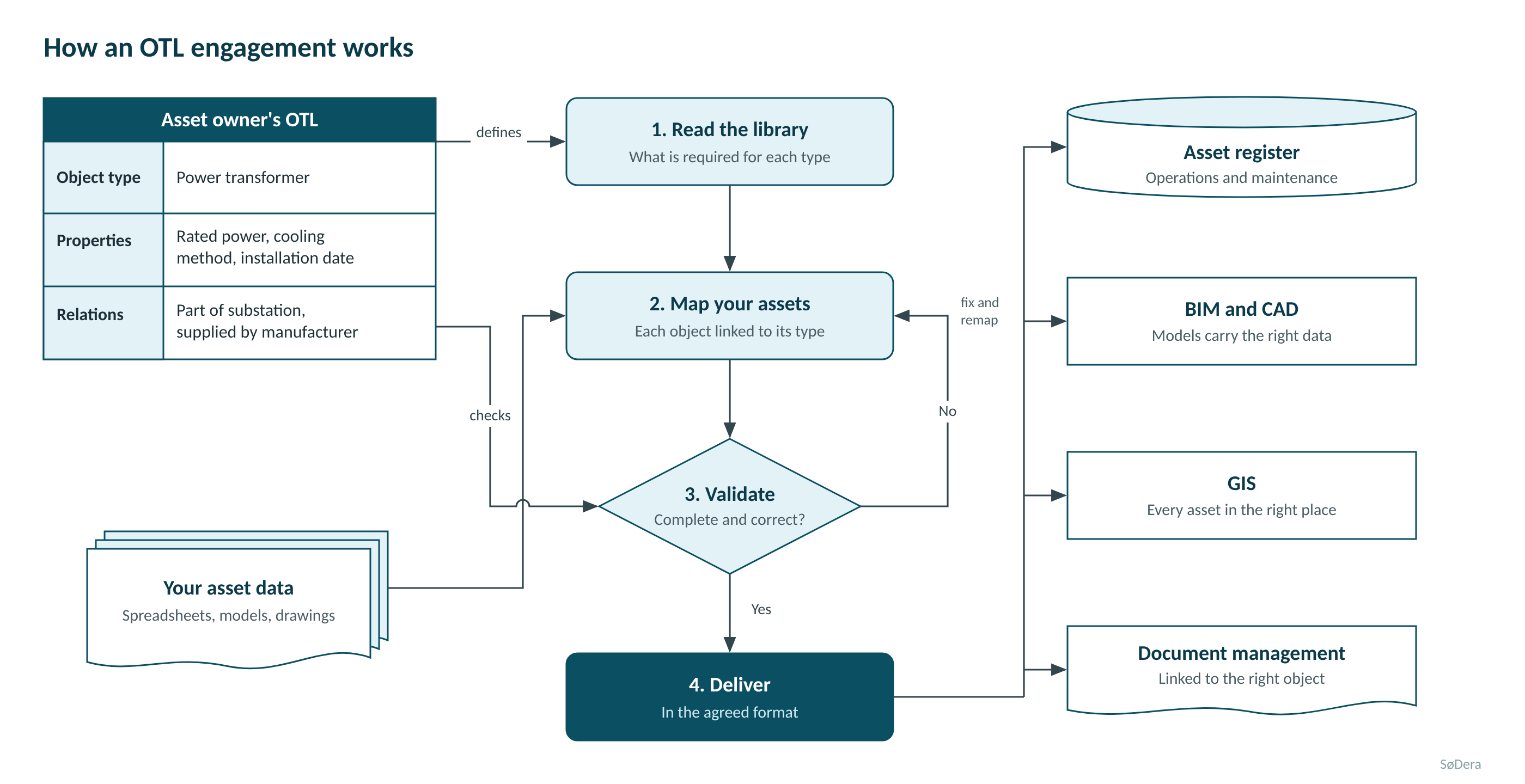
Each object type in the library carries three things. A clear definition, so a transformer means the same thing to the engineer, the contractor and the maintenance system. A set of properties, such as rating, material or installation date, with the unit or value list that is allowed. And relations, which say how objects connect: what an asset is part of, where it sits and who supplied it.
A dictionary helps people agree on words. An OTL does that too, but it is also written so that software can read it. That is what makes it useful beyond a single project. The OTL is the asset owner's structured catalogue: it defines which classes of assets exist in a programme, what attributes each class carries, how object types relate to each other, and which documents each type requires.
The concept emerged from Dutch infrastructure practice in the 2000s, driven by large grid operators and public infrastructure agencies who needed a shared language for data exchange across hundreds of contractors and suppliers. The Netherlands brought it into the NEN 2660 standard series, which provides an ontology for the built environment and a formal basis for linked-data asset management. It has since spread across major infrastructure programmes throughout Europe.
The delivery format for OTL-compliant asset data is typically an ICDD container, defined in ISO 21597. An ICDD package is a structured ZIP archive containing documents, linked data payloads and the index that ties them together. It is machine-readable, version-controlled and auditable, which is exactly why asset owners have moved towards it and away from spreadsheets.
The OTL sits on top of the reference designation system. Assets need consistent identifiers before their attributes can be linked to the right object types. This is why OTL work always connects back to how you designate your assets: RDS-PP, IEC/ISO 81346 or the owner's own designation specification. Without that foundation, OTL mapping produces data that cannot be reliably traced to a physical asset. We cover that foundation in our article on why asset registers and document registers disagree and in our piece on reference designation services.
The business case
Why asset owners are moving to OTLs
Most asset owners run a mix of tools: BIM and CAD for design, GIS for location, an asset register or CMDB for operations, and a document management system holding everything else. Each tool stores data its own way, and every contractor brings its own naming habits. The same pump ends up described five different ways in five places.
An OTL fixes the reference point. Once types, properties and relations are agreed centrally, contractors deliver against that standard, systems can exchange data without manual translation, and the owner can link its data to external sources such as norms, product catalogues and public registers. It also reduces vendor lock-in, because the meaning of the data no longer lives inside one software package.
The asset data standard the OTL creates is also what makes a digital twin useful rather than decorative. A twin that cannot reliably answer which component belongs to which system, or what its rated capacity is, is not an operational tool. The OTL gives it that grounding.
Three ways an OTL gets used
What it actually unlocks
A shared language
People and systems refer to the same concept by the same name, so handovers stop depending on someone remembering what a column meant.
Reuse instead of rework
Data captured once can feed design checks, maintenance planning and reporting without being converted again each time.
Exchange between organisations
Owner, contractor and supplier deliver and receive data against one model, so files arrive in a shape everyone's software can take in.
The three layers underneath a working OTL
Reference designation
Every asset has one consistent identifier across all systems: design, engineering, maintenance, and the owner's asset register. Without this, OTL attributes cannot be reliably linked to a physical object.
Object type mapping
Each asset is assigned to the correct OTL class, and each class defines which attributes are required, what values are valid, and which document types must be attached. The mapping is the core work.
Validated delivery
The data is packaged in the format the owner expects, typically an ISO 21597 ICDD container, and validated against the OTL rules before it leaves your hands. What the owner checks, you have already checked.
An OTL looks clear on paper. In a live project it rarely is.
Engineers do not know which attributes are theirs to fill. Document requirements sit in the wrong discipline. Identifiers get issued twice or not at all. The OTL release changes halfway through the project. And the first data drop arrives before anyone has tested the delivery route.
Every one of these turns into rework, review findings and delay. We have seen them all from both sides of the table, as asset owner and as contractor.
The same pattern that causes BIM validation failures causes OTL delivery failures: requirements that exist as prose rather than executable rules, and validation that happens at the end rather than at every data drop.
Our services
What we do
We work with contractors who must deliver to an owner's OTL and with asset owners who need the OTL to work in practice. Our services cover the full journey from contract award to accepted handover.
OTL readiness assessment
A fixed scope review of where you stand: your asset register, your OTL release, your responsibilities and your delivery route. You get a clear gap list and a plan to close it.
Asset to OTL mapping
We map your assets and systems to the right OTL classes, attributes and document types, and we make the mapping repeatable per system so the next project does not start from zero.
Attribute and document requirements per discipline
We split the OTL into packages engineers can actually work with: one object type, its attributes, its documents, and who fills what. Each discipline gets what it needs and nothing it does not.
Identifier and URI process
We design how assets get their identifiers, who issues them and how they stay linked from design to operation. Linked data delivery depends entirely on this being right from the start.
Data delivery and validation
We set up the delivery route to the client's environment, including container based delivery using ISO 21597 ICDD, and validate the data before it leaves your hands. What the owner checks, you have already checked.
Interim OTL lead
When you need someone to own it, we act as your OTL point of contact towards the asset owner, manage technical queries and keep the plan moving. This includes managing the first data drop and responding to review findings.
Our process
How we work
Assess
We review your contract requirements, OTL release and current data state. This tells us the gap between what you have and what the owner will check.
Map
We connect your asset structure to the OTL and define what each discipline delivers: which attributes, which documents, and which format.
Build the process
Templates, identifier process, validation rules and responsibilities. Every team member knows what they own before the first data entry happens.
Deliver
We support the first data drop and fix what the client's review finds. By this point, most findings are minor because we have already run the same checks.
Hand over
Your team runs it. Documented, trained and repeatable. The next project starts from the mapping we built together, not from zero.
Why partner with us
OTL does not stand alone
OTL sits on top of how you designate your assets and how you manage your documents. We bring all three together: reference designation based on IEC 81346 and RDS-PP, OTL mapping and document management. That is why our mappings survive the first review.
Most OTL support focuses on the mapping spreadsheet. We focus on the process that produces good data before the mapping is filled in. That means the identifier process, the discipline responsibilities, the validation rules and the delivery route. The mapping is the outcome of a working process, not a substitute for one.
Read more on related topics
ISO 21597
ICDD container delivery
NEN 2660
Linked data ontology
IEC 81346
Asset identification
ISO 19650
Information management
We know both sides
We have worked as asset owner and as contractor. We know what the review actually checks and where the data falls apart before it gets there.
Connected to designation and documents
OTL mapping that is disconnected from your designation system produces data that looks right but cannot be traced. We build the connection from the start.
Validation before delivery
We run the same checks the owner will run before the data drop happens. Findings stay internal. What leaves your hands is ready.
Repeatable per system
The first project builds the mapping. Every project after it starts from a verified template. The cost of OTL compliance goes down as the process matures.
Standards
Standards we work with
ISO 21597 (ICDD)
The container format for linked-document delivery. We build and validate ICDD packages to the owner's specification.
IEC 81346 and RDS-PP
The designation frameworks that give every asset a consistent identifier across all systems. The foundation of every OTL mapping we produce.
NEN 2660
The Dutch standard for ontologies in the built environment. Most major OTL implementations in the Netherlands and Northern Europe are built on this.
ISO 19650
The information management standard for built assets. OTL delivery sits within the ISO 19650 information workflow on programmes that use a CDE.
RDF, OWL and SHACL
The linked data formats underlying OTL representations. We work with these when the owner's OTL is published as a formal ontology with validation shapes.
We work with the standards asset owners actually use, including IEC 81346 and RDS-PP for reference designation, ISO 15926 and Linked Data formats such as RDF where the library is published that way, and buildingSMART IDS where delivery requirements are checked against models.
Frequently asked questions
OTL, answered
What is an Object Type Library?
An OTL is the asset owner's agreed list of object types, their attributes, their relations and the documents they require. It makes sure every contractor delivers asset data in the same language, in a format the operator can use without translating or cleaning it first.
We already have a BIM manager. Why do we need OTL support?
BIM covers the model. The OTL covers the asset data the owner will run the asset on for decades. It needs its own process, its own responsibilities and its own validation. Most BIM workflows do not address attribute completeness, identifier consistency, or ICDD container delivery at the level an asset owner's review team will check.
Can you work with our existing tools?
Yes. We work with the asset owner's published OTL and with your current CDE, CMDB and engineering tools. We do not ask you to buy new software. Our job is to make your existing process produce data the owner will accept.
How long does an OTL assessment take?
Most assessments take two to four weeks, depending on the size of the asset base and the documents available. You get a clear gap list and a plan to close it before the first data drop.
From our team